Why insolvency readiness starts before distress
Crypto custodian insolvency planning asks whether the firm can support an orderly response if it becomes unable to continue normal services. It also asks whether clients, administrators or other authorised parties can identify relevant assets, entitlements, pending transactions and third-party dependencies. The legal outcome depends on the entity, contracts, asset structure and jurisdiction. Operational planning cannot guarantee a particular recovery or priority in insolvency.
A firm should not wait for financial distress to assemble its records. Customer agreements, wallet maps, balance histories, key-control records, custodian statements and incident logs may be needed quickly. If that information is spread across systems that depend on the failed provider, reconstructing the position may become harder.
This article complements the pillar guide to crypto custody and client asset protection and the guide to crypto asset segregation and reconciliation.
Identify client entitlements and assets

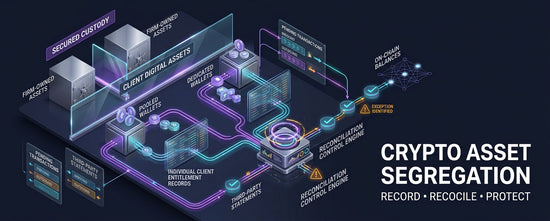
Begin with a reliable inventory that links each client or client group to its asset entitlements, relevant wallet or custody location, governing agreement and transaction history. Include pending deposits and withdrawals, unconfirmed transactions, network fees, asset migrations and unresolved reconciliation breaks. Record where the authoritative evidence sits and who can access it.
The firm should be able to distinguish client assets from its own holdings and explain any pooled arrangement through appropriate records. Ensure that legal terms, ledger design and wallet topology can be read together. If these sources conflict, identify the issue and seek legal advice before relying on a simplified summary.
Set a process for producing an operational snapshot at a defined cut-off. Document data sources, extraction time, exchange or token identifiers, calculation methods, reviewers and known limitations. Preserve historical versions so later changes can be traced.
Preserve access to records and critical services

Access planning should cover people, data, systems and providers. Identify the roles needed to export client records, access custodian reports, contact vendors, secure key material and communicate with clients. Avoid a plan that depends on one senior employee or a single administrator account.
Maintain copies or exports of critical records in a controlled, accessible environment. Test whether backups can be decrypted and read by authorised substitutes. Confirm that the firm can access information even if a SaaS provider suspends normal access, while respecting privacy and security obligations.
For critical third parties, retain current service contacts, contract details, data locations, subcontractor dependencies, termination assistance and asset or record portability steps. Know what the firm can do if the provider becomes unavailable, refuses instructions or experiences a security incident. These are continuity controls; they do not change the legal ownership of assets.
MiCA Article 74 requires crypto-asset service providers to have an orderly wind-down plan for the services covered by Articles 75 to 79, including continuity or recovery of critical activities. Article 75 also addresses custody and administration. Applicability depends on the service and the regulation’s scope. The UK FCA’s 2026 materials state that the new cryptoasset regime, including CASS 17 safeguards, is scheduled to commence on 25 October 2027; firms should not describe future rules as already in force.
Plan transfer, return and communications

An orderly plan should identify decision rights and triggers. For example, a material financial deterioration, loss of a critical provider, prolonged inability to process withdrawals or a regulatory direction may require escalation. Define who assesses the trigger, who can pause activity, who contacts legal advisers and who approves a transfer or return process.
Prepare operational steps for customer communications, identity checks, instruction validation, destination verification, transaction processing and unresolved claims. Communications should explain confirmed facts and next steps without promising timing or recovery outcomes that the firm cannot control. Keep an accessible record of messages and decisions.
Test whether a proposed transfer can be executed in practice. Check asset compatibility, network support, available transaction capacity, fees, destination onboarding and required approvals. If assets are held through a third party, understand which party can initiate or sign the transfer and what documentation it requires.
Exercise the wind-down scenario
A tabletop exercise can walk through a realistic scenario: the custodian is unavailable, records are incomplete, a key approver cannot be reached and several withdrawals are pending. Participants should identify decisions, evidence and communications needed at each stage. A technical test can confirm that data exports and recovery credentials work.
After the exercise, record gaps, owners and due dates. Re-test material fixes. Review the plan after changes to products, wallet infrastructure, key staff, legal entities, service providers or regulatory requirements. The plan should be easy to find and understandable to people who did not design the original custody system.
Frequently asked questions
Can an insolvency plan guarantee that clients recover their crypto?
No. Recovery depends on applicable law, asset ownership, records, asset availability, the insolvency process and other facts. A plan can improve readiness and evidence but cannot guarantee an outcome.
What records are most useful in a custodian failure?
Client entitlements, agreements, wallet and custodian inventories, transaction histories, reconciliations, pending activity, key-control responsibilities, vendor contacts and incident records are commonly important. Tailor the inventory to the service.
Should customers be told that their assets are “bankruptcy remote”?
Only if qualified legal analysis supports that specific claim for the relevant entity, assets and jurisdiction. Avoid broad assurances based solely on wallet separation or marketing language.
How often should wind-down plans be tested?
Set a documented review and exercise schedule based on service criticality and change. Re-test after material changes and after remediation of significant gaps.
Build custody and resilience knowledge
The Crypto Custody, Safeguarding and Client Asset Protection Controls course covers records, governance, operational resilience and insolvency preparedness for custody and compliance professionals.