Tokenomics is the design of a token’s supply, distribution, incentives and use. It explains how tokens are created, allocated, released, earned, spent and sometimes removed from circulation. Good tokenomics does not guarantee success, but weak or opaque design can create dilution, concentrated control, unstable rewards and liquidity shocks.
This guide explains the main terms and shows how to analyse them as risk factors rather than price predictions.
Maximum, Total and Circulating Supply
These figures answer different questions.
| Term | Plain-English meaning | Why it matters |
|---|---|---|
| Maximum supply | the stated upper limit that can ever exist | helps assess long-term scarcity, if technically enforceable |
| Total supply | tokens created minus tokens permanently removed, depending on the data provider’s method | shows existing supply, including locked or non-circulating units |
| Circulating supply | tokens considered available to the market | used in many market-capitalisation calculations |
Always check definitions. Data providers may classify treasury, bridged or locked tokens differently. Then inspect the contract: a published maximum is weaker if administrators can change the minting rules.
Market Capitalisation and Fully Diluted Valuation
Market capitalisation is commonly calculated as:
Token price × circulating supply
Fully diluted valuation (FDV) generally applies the current price to the maximum or eventual supply:
Token price × fully diluted supply
Suppose a token trades at £1, with 100 million tokens circulating and a maximum supply of one billion. Its market capitalisation would be £100 million, while its simple FDV would be £1 billion.
That gap does not prove overvaluation. It shows that much more supply may enter circulation. The important questions are when, to whom, under what conditions and whether demand and liquidity could absorb it.
Token Allocation
Allocation divides supply among groups such as:
-
founders and team;
-
seed and private investors;
-
public sale participants;
-
foundation or treasury;
-
community rewards;
-
ecosystem development;
-
advisers and partners; and
-
liquidity programmes.
Team and investor allocations
Insider allocations align contributors with long-term success only if incentives, vesting and governance are credible. Large or quickly unlocked allocations can concentrate wealth, voting power and potential selling pressure.
Community and ecosystem allocations
These labels sound broad but may still be controlled by a small treasury committee. Determine who decides distributions, what criteria apply and whether transactions are transparent.
Treasury allocation
A treasury can fund development and resilience. It can also create risk if one party can sell large amounts, make undisclosed grants or change policy without oversight.
Vesting and Cliff Periods
Vesting releases tokens over time. A cliff is an initial period during which nothing becomes transferable. After the cliff, tokens may unlock all at once or gradually.
Example:
-
Team receives 20% of supply.
-
There is a 12-month cliff.
-
After month 12, 25% of the team allocation unlocks.
-
The remainder releases monthly over 36 months.
This structure delays some insider liquidity. However, risk still depends on the size of the allocation, enforceability of the lock, holder incentives and market depth at each release.
How Token Unlocks Affect Risk
A token unlock makes previously restricted units transferable. Possible effects include:
-
higher circulating supply;
-
dilution of existing holders’ share of the circulating amount;
-
increased selling capacity;
-
changed governance power;
-
improved liquidity if tokens are distributed broadly; or
-
uncertainty before a large release.
Do not assume every unlock causes a price fall. Recipients may hold, stake, use or redistribute tokens. Markets may also anticipate public schedules. The responsible conclusion is that an unlock changes supply conditions and should be assessed with demand, concentration and liquidity.
Questions for each unlock
-
How many tokens unlock?
-
What percentage of circulating supply does that represent?
-
Who receives them?
-
Is the release one-off or continuous?
-
Can the schedule change?
-
Is the vesting enforced by code, custody or contract?
-
How deep is the market?
-
What happened around previous releases?

Minting, Emissions and Supply Inflation
Minting creates new tokens. Emissions distribute tokens according to a schedule, often for staking, mining, liquidity or ecosystem rewards.
Inflation is not automatically harmful. It can pay for network security or encourage participation. The key question is whether rewards create durable activity or merely attract users who sell newly issued tokens.
Calculate net supply change, not only headline emissions. Burns, lost tokens or locked balances may offset issuance, while administrator minting may add uncertainty beyond the published schedule.
Staking Rewards
Staking may help secure a network or distribute governance. Analyse:
-
where rewards come from;
-
whether rewards are paid through new issuance, fees or both;
-
who can participate;
-
lock-up and unbonding periods;
-
validator concentration;
-
slashing or technical risks; and
-
whether advertised yields are shown before inflation.
A 10% token-denominated reward does not necessarily increase real purchasing power if supply expands quickly or token demand falls.
Token Burns
Burning removes tokens from usable supply, usually by sending them to an inaccessible address or using contract logic.
Burns may be:
-
scheduled;
-
linked to transaction fees;
-
discretionary; or
-
paired with minting.
“Deflationary” marketing deserves scrutiny. A burn can be smaller than emissions, discretionary rather than guaranteed or economically insignificant. Check net supply and technical enforcement.
Holder Concentration
Holder concentration measures how much supply is controlled by the largest holders.
Concentration can create:
-
market impact if a large holder sells;
-
governance capture;
-
liquidity dependence;
-
conflicts between insiders and public users; and
-
misleading impressions of decentralisation.
Raw holder tables need interpretation. A top wallet may be an exchange, bridge, burn address, staking contract or treasury. Label addresses before calculating meaningful concentration, and consider whether several wallets share an owner.
Liquidity and Tokenomics
Supply only becomes market pressure when tokens can trade. Therefore, tokenomics and liquidity must be assessed together.
A release equal to 2% of circulating supply may be manageable in a deep, diverse market but disruptive in a pool with shallow reserves. Similarly, a token may have broad holder distribution but depend on one project-controlled market maker.
Review:
-
executable depth;
-
spreads and slippage;
-
liquidity-pool ownership;
-
venue concentration;
-
market-maker terms;
-
trading restrictions; and
-
liquidity incentives and their expiry.
Governance Tokens and Voting Power
Governance tokens may let holders vote on fees, upgrades, treasury spending or risk parameters. Token ownership therefore translates into control.
Ask:
-
Is voting based purely on token balance?
-
Can votes be delegated?
-
What quorum and approval thresholds apply?
-
Can administrators override the result?
-
Is there a time lock before implementation?
-
Do team and investor allocations create effective control?
Formal voting can still be centralised if turnout is low or a few delegates dominate.
Supply Shocks
A supply shock is a sudden change in available supply. It may result from:
-
a cliff unlock;
-
administrator minting;
-
treasury distribution;
-
migration to a new contract;
-
bridge failure or recovery;
-
release of previously frozen tokens; or
-
removal of liquidity incentives.
Map these events in advance. The risk is greater where disclosure is weak, the amount is large compared with circulation and market depth is low.
A Practical Tokenomics Assessment
Use this five-part framework.
1. Supply integrity
Confirm current supply, maximum or eventual supply, minting powers, burns and data-provider definitions.
2. Distribution fairness and concentration
Map allocations, beneficial control, top holders and governance power.
3. Release pressure
Create a 12–24 month calendar of vesting, emissions, cliffs and discretionary treasury releases.
4. Demand and utility
Identify why people use or hold the token and whether that activity exists today.
5. Market capacity
Compare possible new supply with executable liquidity and venue quality.
| Finding | Lower-risk feature | Higher-risk feature |
|---|---|---|
| Supply | transparent and technically bounded | changeable or inconsistently reported |
| Allocation | explained and distributed | hidden or heavily insider-weighted |
| Vesting | gradual, enforceable and public | large cliff or changeable schedule |
| Rewards | linked to network value | funded mainly by unsustainable issuance |
| Governance | checks, participation and time locks | concentrated or overrideable |
| Liquidity | deep and diversified | shallow or controlled by one party |
Comparing Two Fictional Token Designs

Assume Token A and Token B each have a maximum supply of one billion units. That headline figure makes them look similar, but their risk profiles differ.
Token A has 650 million units circulating. Its remaining supply releases gradually over five years. The largest beneficial holder controls 6%, governance changes require a time lock and liquidity is spread across several established venues.
Token B has only 80 million units circulating. The team and early investors control 600 million units, with 200 million due to unlock in three months. One administrator can alter emissions, while most liquidity sits in a project-funded pool.
The maximum supply alone misses the important differences. Token B has a larger gap between circulating and future supply, more concentrated economic and governance power, a nearer supply event and greater liquidity dependence. Token A is not automatically safe, and Token B is not automatically fraudulent. However, Token B requires deeper investigation of vesting enforceability, administrator powers, expected market capacity, insider incentives and disclosure.
This comparison also shows why token price is not enough. A low unit price can coexist with a high fully diluted valuation, while a high unit price can represent a smaller total supply. Analyse the whole structure rather than deciding that one token “looks cheaper” because each unit costs less.
Tokenomics Is Not the Whole Risk Assessment
Strong tokenomics cannot repair exploitable code, illegal promotion, sanctions exposure or dishonest governance. Weak tokenomics may also be manageable in a limited-use token with clear disclosure and controls.
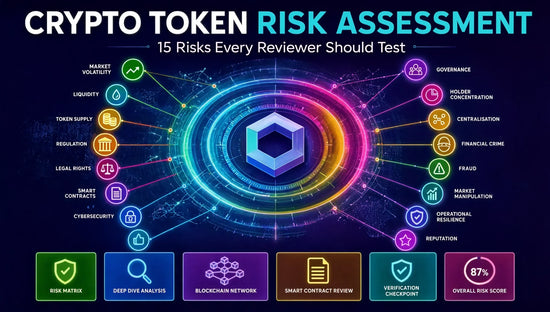
Combine the findings with the 15-part crypto token risk assessment and investigate relevant crypto token red flags.
Frequently Asked Questions
What is tokenomics?
Tokenomics is the design of a token’s supply, distribution, release, incentives, utility and removal mechanisms, together with the behaviour those features encourage.
What is circulating supply?
Circulating supply is the amount considered available to the market. Definitions can differ, so check how locked, treasury, bridge and project-controlled tokens are treated.
What is fully diluted valuation?
FDV generally applies the current token price to the maximum or eventual supply. It highlights potential future supply but is not a complete valuation method.
Why do token unlocks matter?
Unlocks increase the amount recipients can transfer. They may change circulating supply, selling capacity, liquidity and governance power.
Is a large maximum supply always bad?
No. Unit count alone says little. Release rate, allocation, demand, utility, market depth and minting controls matter more.
Are token burns always positive?
No. A burn may be small, discretionary or outweighed by new issuance. Assess net supply change and economic significance.
How can I check token holder concentration?
Review the relevant block explorer, label known exchange and contract addresses, and investigate whether separate wallets are related.
Can good tokenomics make a token low risk?
Not by itself. Legal, smart-contract, cybersecurity, operational, financial-crime, market and governance risks must also be assessed.
Conclusion
Tokenomics explains who receives tokens, when supply changes, what incentives exist and how ownership can become market or governance power. Focus on enforceable mechanics rather than labels. Compare future releases with circulating supply, holder concentration, utility and executable liquidity.
Return to the token listing due diligence guide to see how tokenomics fits into a broader admission and monitoring decision.
Build a more complete understanding of token design alongside legal, technical, market and financial-crime risk with the Token Listing Due Diligence and Cryptoasset Risk Assessment course.